Counting the Omer, Two Views, One Season

Counting the Omer, Two Views, One Season


Image

There are fifty days of counting from Firstfruits [HaBikiurrim] of the Barley to Pentecost [Shavuot]. It was during these days, in 30 A.D., that all of the post resurrection appearances of Messiah were witnessed.  "Until the day in which He was taken up, after that He through the Holy Ghost had given commandments unto the apostles whom He had chosen:  To whom also He shewed Himself alive after His passion by many infallible proofs, being seen of them forty days, and speaking of the things pertaining to the kingdom of God:  And, being assembled together with them, commanded them that they should not depart from Jerusalem, but wait for the promise of the Father, which, saith He, ye have heard of Me" (Acts 1:2-4).

What an awesome time they had as they spent the first forty days counting the omer with Messiah Yeshua! It was only a ten day wait until the harvest festival of Shavuot, and they all waited together with great anticipation for the fulfillment of Yeshua's final instructions as He ascended.

"But ye shall receive power, after that the Holy Ghost is come upon you: and ye shall be witnesses unto me both in Jerusalem, and in all Judaea, and in Samaria, and unto the uttermost part of the earth.  And when He had spoken these things, while they beheld, He was taken up; and a cloud received Him out of their sight.  And while they looked steadfastly toward heaven as He went up, behold, two men stood by them in white apparel;  Which also said, Ye men [people] of Galilee, [this group includes the women who followed Him from Galilee] why stand ye gazing up into heaven? This same Jesus, which is taken up from you into heaven, shall so come in like manner as ye have seen Him go into heaven.  Then returned they unto Jerusalem from the mount called Olivet, which is from Jerusalem a Sabbath day's journey.  And when they were come in, they went up into an upper room...These all continued with one accord in prayer and supplication, with the women, and Mary the mother of Jesus, and with his brethren." (Acts 1:8-14)

The count for these  fifty days of the omer begins either on the first day after the annual Sabbath of Unleavened Bread, Aviv 16, according to the tradition of the Pharisees. Or it can begin on the day after the weekly Sabbath during the Week of Unleavened Bread, according to the  tradition of the ancient Sadducees. Either way the count is the same, but the days set apart for the celebrations, and therefore the Sabbath of Shauvot will be different.

According to Judaism 101 (at the site: jewfaq.org): "There was, at one time, a dispute as to when the counting should begin. The Pharisees believed that G-d gave Moses an oral Torah along with the written Torah, and according to that oral Torah the word "Shabbat" in Lev. 23:15 referred to the first day of Passover [Sabbath of Unleavened Bread], which is a "Shabbat" in the sense that no work is permitted on the day... In this view, held by most Jews today, the counting begins on the second night of Passover, that is, the day after the non-working day of Passover [first annual Sabbath of Unleavened Bread]. The Tzedukim (Sadducees) rejected the idea of an oral Torah and believed that the word "Shabbat" in Lev. 23:15 referred to the Shabbat of the week when Pesach began, so counting would always begin on a Saturday night during Passover. The Sadducees no longer exist; today, only a small sect call the Karites follow this view." (The information in brackets was added for clarification.)

In the time of Messiah's death, burial, resurrection and ascension, the Sadducees controlled the Temple services, so their application is the one that fits the Passion week of Yeshua, as discussed in the previous blog post titled, "Firstfruits and the Resurrection of Messiah Yeshua".

After the previous blog post, a man challenged my conclusions.  His claim was that the giving of the Torah on Sinai was "exactly" 50 days after Firstfruits. While I greatly value the giving of Torah at Sinai, Jewish teachings do not confirm this as fact. Shavuot is the season for the Revelation of Torah, not the exact date.

According to The Jewish Book of Why, the Sivan 6th date for Shavuot was determined not from the Bible, but from the Talmud. The connection to the Revelation of Torah at Sinai was not incorporated into Judaism until the 3rd century, after the destruction of the Temple. Yes, the giving of Torah occurred in the third month, according to Ex. 19, but the exact date was not designated in the Bible. Shavuot is the season of the Revelation of Sinai, it is not the day of the event.

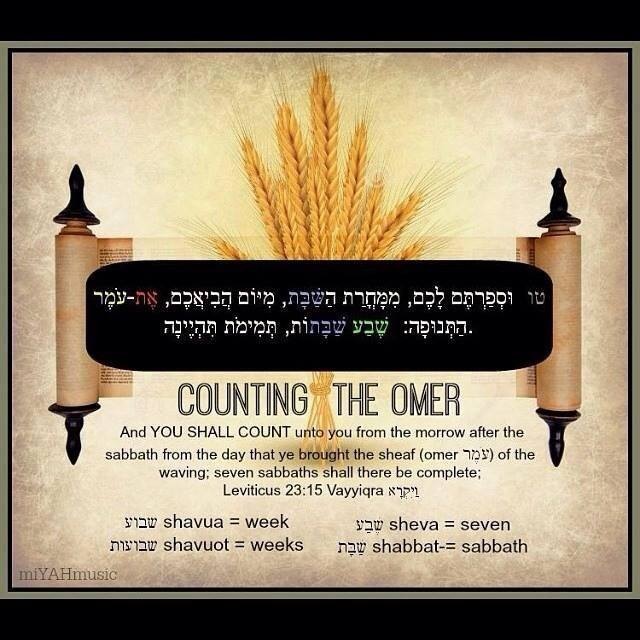
The Torah tells us that the Sabbaths are connected to the observance of Shavuot. Leviticus 23:15, “And ye shall count unto you from the morrow after the Sabbath, from the day that ye brought the sheaf of the wave offering; seven Sabbaths shall be complete”. Shavuot is not indicated in Scripture as occurring “exactly 50 days later” than the Exodus from Egypt.

Once again, referring to The Jewish Book of Why, “The Bible in no way associates the holiday of Shavuot with God’s Revelation on Mount Sinai. The Talmud, however, does make an association between the two. Apparently, the connection was established when scholars, following the biblical account, calculated that the dates of the agricultural festival of Shavuot and the events at Mt. Sinai coincided…The Bible does not connect Shavuot with the giving of the Tora on Mount Sinai…The earliest reference to Shavuot as ‘the time of the giving of the Tora [Zeman Mattan Toratenu]‘ is in the Talmud. The third-century C.E. scholar Rabbi Eleazar said that all authorities agree on the necessity of rejoicing with good food an wine on Atzeret (the talmudic name for Shavuot) because on that day the Tora was given to Israel (Pesachaim 68b). Shavuot became increasingly associated with the Revelation at Mount Sinai because, as a purely agricultural holiday, it had lost its significance. The Jews of Palestine had become an urban people, and to keep the holiday alive it became necessary to associate the Shavuot holiday with an historical event. The event chosen was the Revelation because it occurred about the same time of the year that the agricultural festival of Shavuot was celebrated.” [The Jewish Book of Why pages 211-214, 1981 edition].

Perhaps the season of Shauvot is the reason to celebrate and we should not get caught up with being "accurate". The date is deliberately vague in the Scriptures, and perhaps that is good with our God. The rabbis determined that the dates of the Biblical holidays may not be observed on time in the diaspora, and recommended that those outside of Israel celebrate for more than one day.  Perhaps we, in the dispersion, could consider both Jewish views for the observance of Shavuot.  One would align us with the Pharisees determination, upheld by the rabbis of the nation of Israel, for the Sabbath of Shavuot. The other count, beginning on the first day of the week, would keep us in line with the Sadducees decision of the first century, which was the timing of events that took place at the resurrection  and ascension of Messiah. Maybe it is not an either/or choice. Maybe both choices are worthy of keeping for their own unique reasons.

Scripture tells us, to keep the annual Sabbaths during their times and seasons. If your local congregation has proclaimed a day set aside for rejoicing and gathering together, it would be good to join with them, whatever day they have determined is best. Being in one accord with the local body takes precedence over being "correct". It is never "right" to avoid assembling  with the local fellowship, we are in community with. Especially, it is not "correct" to elevate ourselves over the rest of the congregation, because we prefer our private interpretation of Scripture over that of the  shepherds who have gathered the flock.

Torah tells us, "Speak unto the children of Israel, and say unto them, Concerning the feasts of the LORD, which ye shall proclaim to be holy convocations, even these are my feasts.  Six days shall work be done: but the seventh day is the Sabbath of rest, an holy convocation; ye shall do no work therein: it is the Sabbath of the LORD in all your dwellings.  These are the feasts of the LORD, even holy convocations, which ye shall proclaim in their seasons" (Lev. 23:2-4). Each local assembly should proclaim they days they are setting aside to celebrate the feast of the LORD, so that everyone can gather in one accord.

It is good to join in unity with our local congregations.  Being in one accord is the reason for the Shavuot season. Joining together for feasting, study, prayer, and worship is what the first century Believers did, and God blessed them with the outpouring of the Ruach/Holy Spirit. Bickering over who is more accurate, or what calender to follow , is not what Firstfruits is about. It is not the Feast of Bickering , but  the Feast of HaBikkurim, a holiday of gathering the sheaves, not scattering them.  Abba wants His children to come together with  an attitude of Hine MaTov. "Behold, how good and how pleasant it is for brethren to dwell together in unity!   It is like the precious ointment upon the head, that ran down upon the beard, even Aaron's beard...for there the LORD commanded the blessing, even life for evermore. (Ps. 133:1-3).

If we want the oil of the Ruach to flow, we need to come together in one place. "And when the day of Pentecost was fully come, they were all with one accord in one place.   And suddenly there came a sound from heaven as of a rushing mighty wind, and it filled all the house where they were sitting"(Acts 2:1-2).

May this Shavuot season fill you with the power of the Ruach as you grow in the grace and knowledge of our Lord and Savior. May His mercy surround you during the counting of the omer as we anticipate the days ahead. 
Firstfruits and the Resurrection of Messiah Yeshua

Firstfruits and the Resurrection of Messiah Yeshua

Image

The Firstfruits of the resurrection is a term that the New Testament gives to define the Messiah. Firstfruits is not a Sabbath, but it is a Biblical holy day that commemorates the greatest defeat of the enemy of our God. When death was given its final blow, and life was restored by the blood of the Lamb. Anciently, this day was celebrated as an agricultural festival of the first harvest of barley. It is a fully loaded holiday on many levels. When Messiah said He did not come to abolish the Torah of Moses, but to make it full, Firstfruits is ripe with fullness for both the Jew and non-Jew in Messiah Yeshua.  It is a holy day that can be determined by Scripture, by two differing dates on the Biblical calendar.

Our local congregation has aligned itself with the Jewish calendar, to create unity, for both the Jew and the non-Jew, in honoring the Feasts of the LORD. Therefore, we are in one accord with the Jewish people, and the nation of Israel, for all the Biblical holidays, with an exception of two days. These two are the Feast of Firstfruits, and therefore, the celebration of Shavuot, which is a 50 day count from Firstfruits. There are two opinions on this topic, based on the interpretation of Scripture, one originating with the Sadducees, and one with the Pharisees. The diverse opinions creates differing days of celebrating the holidays.

Each year, we pray and seek how best to celebrate the Feast of First Fruits, in a way that is honoring to Messiah Yeshua. As a result, Abba has revealed some things that confirm the reasons to continue celebrating Firstfruits as the day after the weekly Sabbath, rather than the annual Sabbath for Unleavened Bread. One of them is rather humorous because of its irony.

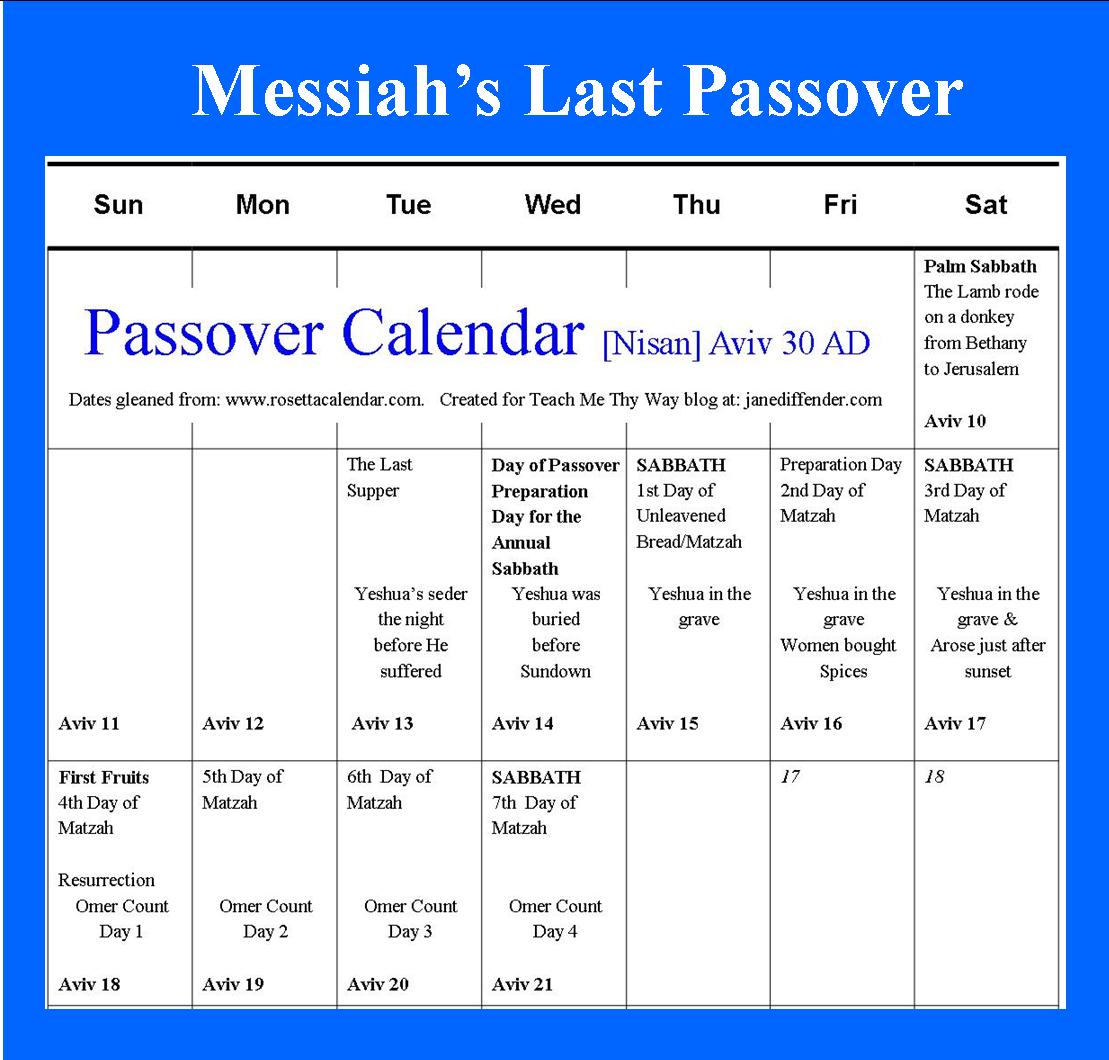
In the year that Yeshua suffered to redeem us from the bondage of sin, the days on the Biblical calendar aligned so that Passover was on a Wednesday, and the annual Sabbath of Unleavened Bread was on a Thursday. There was a discrepancy in the first century, and even today, as to which Sabbath the Scriptures refer to about the observance of Firstfruits. Here are the words from Torah about these Spring Feasts:

"Speak unto the children of Israel, and say unto them, When ye be come into the land which I give unto you, and shall reap the harvest thereof, then ye shall bring a sheaf of the firstfruits [of barley] of your harvest unto the priest:  And he shall wave the sheaf before the LORD, to be accepted for you: on the morrow after the Sabbath the priest shall wave it.  And ye shall offer that day when ye wave the sheaf a he lamb without blemish of the first year...it shall be a statute for ever throughout your generations in all your dwellings.  And ye shall count unto you from the morrow after the Sabbath, from the day that ye brought the sheaf of the wave offering [Firstfruits of the barley]; seven sabbaths shall be complete: Even unto the morrow after the seventh Sabbath shall ye number fifty days [until Shavuot/Pentecost]..."(Lev. 23:10-16).

If we used today's modern Jewish reckoning, from the perspective of the Pharisees, Firstfruits would always occur on the 16th day of Aviv, and there would be no need to count the days. Shavuot/Pentecost would always occur on Sivan 6. This calendar determination causes one to lose the picture of Messiah Yeshua being buried in the tomb for three full three days and nights, with His resurrection at that end of the weekly Sabbath. Counting from the 14th of Aviv to the 16th day, doesn't reveal the sign of Jonah. Messiah Yeshua told us, as recorded in all three synoptic Gospels, "...An evil and adulterous generation seeks after a sign; and there shall no sign be given to it, but the sign of the prophet Jonas: For as Jonas was three days and three nights in the whale's belly; so shall the Son of man be three days and three nights in the heart of the earth." (Matt. 12:39-40).

The ancient Sadducees reckoned the day for Firstfruits as the day after the weekly Sabbath (Saturday) and therefore, the Biblical holidays for Firstfruits and Shavuot would always occur on Sunday. This aligns with the Biblical calendar in the year 30 A.D. when Messiah was crucified (see: www.rosetacalendar.com). This calendar reckoning of the days allows for the sign of Jonah to be fulfilled. Messiah was crucified on Passover, Aviv 14, a Wednesday. The annual Sabbath of Unleavened Bread followed on Thursday. Counting the three days and nights, the 15th (Thursday), 16th (Friday), and 17th (Saturday) of Aviv, brings us to the end of the Sabbath day. These three days fulfill the sign of Jonah with the resurrection occurring at the end of the weekly Sabbath, at the eve of the first day of the week, at the exact time the Sadducee temple priests were harvesting the first fruits of barley. This would have made Aviv 18th the day of Firstfruits in the year of Messiah's passion.

Messiah's Last Passover - square

This where the understanding of these events takes a ironic turn. The Sadducees, while they were right in their reckoning of the day of Firstfruits, by beginning the count on the day after the weekly Sabbath, they missed the entire significance of the day. The Biblical holiday of Firstfruits is about the Resurrection of the Messiah. The Sadducees, in opposition to the Pharisees, did not believe in the resurrection of the dead! ( Matt. 22:23). To make matters worse, the Pharisees, who did believe in the resurrection, determined a calculation of days, that actually deny the three days and nights, of the sign of Jonah. What an irony!  The Jewish religious leaders did not comprehend the meaning of Firstfruits in the resurrection of the  One, who is the WAY, the TRUTH, and the LIFE in the days they lived.

With the Sadducee's interpretation of Firstfruits, we find that Messiah Yeshua was raised from the dead on the first day of the week, on the 18th day of Aviv. In Hebraic thinking, the number 18 is the number for LIFE! The Hebrew word for life is chai, formed from the letters from the Hebrew Alef Bet, of Chet and and a Yod. The numeric value of Chet is eight, and the value of Yod is ten. Therefore, the First Fruits of the Resurrection occurred on the exact day that would indicate LIFE, resurrection LIFE!

Chayah (Chet, Yod, Hey) is the Hebrew word for REVIVE, a demonstration of  the resurrected power, the LIFE of God. Chayah's word picture means to behold the resurrection. The Hallel Psalm that is sung for Passover includes these verses: "The voice of rejoicing and salvation [Yeshuah] is in the tabernacles of the righteous: the right hand of the LORD [Yahweh] does valiantly. The right hand of the LORD is exalted: the right hand of the LORD does valiantly.  I shall not die, but live [chayah], and declare the works of the LORD (Psalm 118:15-17).

The New Covenant Scriptures confirm what was written in the First Covenant Scriptures about the Feast of Firstfruits. "For if the dead rise not, then is not Christ raised:  And if Christ be not raised, your faith is vain; ye are yet in your sins. Then they also which are fallen asleep in Christ are perished. If in this life only we have hope in Christ, we are of all men most miserable. But now is Christ risen from the dead, and become the firstfruits of them that slept. For since by man came death, by man came also the resurrection of the dead. For as in Adam all die, even so in Christ shall all be made alive. But every man in his own order: Christ the firstfruits; afterward they that are Christ's at His coming. (Corinthians 15:16-23)

Just as Messiah Yeshua was resurrected to LIFE on the 18th day as the Firstfruits of the Resurrection, we can anticipate the future resurrection of the righteous when He returns to gather up His bride. For we shall not die, but LIVE forever with Him.

LaChayim! To LIFE!

Chag Sameach! Joyous Feast of Firstfruits to you all!

The Greater Exodus – Our Future Deliverance – Part 2

The Greater Exodus – Our Future Deliverance – Part 2

Image

The exodus from Egypt is a prophecy for Believers today. During the last days, before Messiah returns, deception will be on the rise. We need to be aware of the Enemy’s ability to manipulate through his counterfeit movements. To see this deception in action, and to see the awesome power of our God, let us recall the miraculous events in each of the plagues against Egypt.

The First Plague - Blood

“And the LORD spoke unto Moses, ‘Say unto Aaron, Take thy rod, and stretch out thine hand upon the waters of Egypt, upon their streams, upon their rivers, and upon their ponds, and upon all their pools of water, that they may become blood; and that there may be blood throughout all the land of Egypt, both in vessels of wood, and in vessels of stone.’ And Moses and Aaron did so, as the LORD commanded…” (Exo. 7:19-20)

This first plague went throughout all of Egypt; even the Hebrew slaves suffered this hardship. In response, the magicians in Pharaoh’s court attempted to duplicate Yahweh’s power, and because they brought forth the same miracle, Pharaoh’s heart grew hard. He would not heed the authority of Moses and Aaron.

We find parallels of such hard-heartedness in our world today. Messiah told us that in the last days, people will, “…be offended, and shall betray one another, and shall hate one another. And many false prophets shall rise, and shall deceive many. And because iniquity shall abound, the love of many shall wax cold.” (Matt. 24:10-12) Those who do not soften at the Word will find themselves hardened by it. If we do not keep God’s commandments, and love one another, our hearts will harden. The same Word of God will produce different results, in different kinds of people. A soft heart will melt like wax when exposed to the heat of the Word.  A hard heart will dry out like clay, when exposed to the same heat. The Word of God is a discerner of our thoughts and the purposes of our hearts. When things heat up, and the pressure is on, the truth comes forth.

The Second Plague – Frogs

“And the LORD spoke unto Moses, ‘Say unto Aaron, Stretch forth thine hand with thy rod over the streams, over the rivers, and over the ponds, and cause frogs to come up upon the land of Egypt.’ And Aaron stretched out his hand over the waters of Egypt; and the frogs came up, and covered the land of Egypt. And the magicians did so with their enchantments, and brought up frogs upon the land of Egypt.” (Exo. 8:5-7).

Once again the Egyptian magicians were able to produce a similar wonder. Because of the blindness of our humanity, darkness and light can sometimes seem indistinguishable to our natural minds. Therefore, we must have the discernment from Yahweh. If it may be possible for the very elect to be deceived, then the deceit must be shrouded to appear as truth. The Apostle Paul warned of this counterfeit in his writings to the Corinthians. “And no marvel; for Satan himself is transformed into an angel of light. Therefore it is no great thing if his ministers also be transformed as the ministers of righteousness; whose end shall be according to their works.” (2 Cor. 11:14-15)

Paul also warned of this end times deception in Second Thessalonians, And then shall that Wicked be revealed, whom the Lord shall consume with the Spirit of His mouth, and shall destroy with the brightness of His coming:  Even him, whose coming is after the working of Satan with all power and signs and lying wonders…” These powerful signs and lying wonders are real, but the source of the power is from Satan with the expressed purpose of deceiving. Why is the human lust for power so strong that some will open themselves up to deception? Why are people seduced into following false prophets? Second Thessalonians continues with the answer, “And with all deceivableness of unrighteousness in them that perish; because they received not the love of the truth, that they might be saved.  And for this cause God shall send them strong delusion, that they should believe a lie: That they all might be damned who believed not the truth, but had pleasure in unrighteousness.”(2 Thes. 2:8-12)

We need to meditate on the eternal consequences of these verses. Love is the answer. The love of the truth is our only defense against both the delusion and the deception of the last days. Do not let your love grow cold. If we do things contrary to the Word, or if we do not love the truth above all else, we will find ourselves open to lying and deluding spirits (see 1 Kings 22:22-23).

What is truth?

When Messiah Yeshua was brought before the authority of Rome, Pilate asked Him, “’Art  thou a king then?’ Jesus answered, ‘Thou say that I am a king. To this end was I born, and for this cause  I came into the world, that I should bear witness unto the truth. Every one that is of the truth hears my voice.’ Pilate said unto Him, ‘What is truth?’” (John 18:37-38) The very Word of God, manifested in the flesh, stood before Pilate, and he was so blind, that he could not see. Yeshua came to bear witness to the truth. According to Scripture, “Thy righteousness is an everlasting righteousness, and thy law [Torah] is the truth.” (Psalm 119:142) The widow of Zarephath, also testified about the truth. After the resurrection of her son, she knew that the word in the Prophet Elijah’s mouth was truth. “And the woman said to Elijah, ‘Now by this I know that thou art a man of God, and that the word of the LORD in thy mouth is truth.’” (1 Kings 17:24)

When Yeshua came to bear witness to the truth, He came to uphold the Torah and the Prophets. In His transfiguration on the mountain, Moses and Elijah, representing Torah and the Prophets, stood with Messiah. Everyone who hears Yeshua’s voice should be in agreement with the truth of Torah and the Prophets. If anyone speaks against the eternal truths of Torah and the Biblical Prophets, we are not to listen to them. Even if the seemingly “anointed” teacher manifests both signs and wonders, we must be wary of the intent of his words. “Bind up the testimony, seal the law among my disciples….To the law and the testimony: if they speak not according to this Word, it is because there is no light in them.” (Isa. 8:16-20)

Deluded teachers say and do things that oppose the Word; they speak against the Torah and the Prophets. They claim that:  “the Law is done away with” or “the Torah is only for the Jews”. False leaders and teachers prophesy things that are contrary to what is written in Daniel, Hosea, Joel, Jeremiah, Ezekiel, Isaiah, etc. Yet the New Covenant Scriptures state,“…the spirits of the prophets are subject to the prophets.” (1 Cor. 14:3) To be subject to the Biblical prophets is not something taught in most seminaries today. The prophets we embrace should be in agreement with the Prophets of Ancient Israel. We need to be a people who are working toward “…the restoration of all things, which God hath spoken by the mouth of His holy prophets since the world began.” We are told in Acts 3:21, that Yeshua will not return until the words of the Prophets are fulfilled. If you desire His Kingdom to come and His will to be done, then seek out what Moses (Torah) and Elijah (The Prophets) have to say to our generation.

What is the purpose of the Prophets of the Hebrew Scriptures? They are crying out for Israel and Judah to repent and return to the Holy One of Israel, to remember His Covenant, based in Torah. They also foretold of the reason why God would need to initiate the New Covenant and how Messiah Yeshua will restore the Kingdom to Israel. If you hear a prophet who utters something that is incongruent with prophets of Scripture, it is because that prophet is not subject to the Biblical Prophets and is, consequently, missing the aim of Torah.

The Third Plague - Lice

The LORD said, “’Stretch out thy rod, and smite the dust of the land, that it may become lice throughout all of the land of Egypt.’ And they did so…And the magicians did so with their enchantments to bring forth lice, but they could not…Then the magicians said unto Pharaoh, ‘This is the finger of God’: and Pharaoh’s heart was hardened…” (Exo. 8:16-19) After this third plague, Yahweh makes a distinction between His power and the power of the Satan. The magicians can no longer compete. Even still, Pharaoh refused to listen because he was deluded into thinking that he was a god. Pharaoh’s pride was preceding his fall. To avoid this same calamity we are instructed in Scripture to do what the LORD requires of us, “to do justly… love mercy, and to walk humbly” with our God (Micah 6:8). Walking humbly, in the fear of the LORD, will convert our souls and save us from the wrath that is to come. Because we serve a just God, justice will come forth through His judgments upon the earth. For those who have His Torah written on their heart, there is nothing of this world to fear. The only positive fear is the fear of the LORD. “The law of the LORD is perfect, converting the soul: the testimony of the LORD is sure, making wise the simple. The statutes of the LORD are right, rejoicing the heart: the commandment of the LORD is pure, enlightening the eyes. The fear of the LORD is clean, enduring for ever: the judgments of the LORD are true and righteous altogether.” (Psa. 19:7-9)

The Fourth Plague - Flies

This plague was against Egypt and Egypt alone. Prior to this plague, no distinction was made between the Hebrews and the Egyptians. The first three plagues were as difficult for the Hebrew slaves as for their Egyptian masters. However, with the announcement of the fourth plague, the LORD said, “Let my people go, that they may serve me. Else, if thou wilt no let my people go, behold, I will send swarms of flies upon thee…And I will sever in that day the land of Goshen, in which my people dwell, that no swarms of flies shall be there…And I will put a division between my people and thy people: tomorrow shall this sign be.” (Exo. 8:20-23)

As the plagues became more sever, a distinction began to show between who followed the God of Israel and who did not. This demonstrates that Believers can have, and will suffer trials and tribulations. They can suffer the same as those of the world, as the LORD brings forth His judgments on the earth, but it only lasts for a season. Ultimately, Yahweh makes a distinction between those who do, and those who do not, belong to Him. Messiah Yeshua also referred to this distinction. “Wherefore by their fruits ye shall know them. Not everyone that says unto me, Lord, Lord, shall enter into the kingdom of heaven; but he that doeth the will of my Father which is in heaven.  Many will say to me in that day, Lord, Lord, have we not prophesied in thy name, and in thy name have cast out devils, and in thy name done many wonderful works?  And then will I profess unto them, I never knew you: depart from me, ye that work iniquity.” (Matt. 7:20-23)

As we celebrate Passover each year, we remember the wonderful truth that our God is going to deliver us.  In the Lord’s Prayer, the Greek word translated “deliver” means to draw to one’s self, to rescue. So when we pray, “Lead us not into temptation but deliver us from evil”, we are asking the Lord to rescue us by drawing us to Himself so that evil is not allowed to come near where we dwell. When we do suffer trials in this life, we can draw near to Him and let Him keep us in the shadow of His wings. We hide and abide in His tallit (prayer shawl) of love. “Thou art my hiding place and my shield: I hope in thy word.” (Ps. 119:114)

The fourth plague upon Egypt begins the last seven plagues. In the book of Revelation, the last seven plagues are where the wrath of God is poured out. “I saw another sign in heaven, great and marvelous, seven angels having the seven last plagues, for in them is filled up the wrath of God.” (Rev. 15:1) The Elect may go through a season of judgment and tribulation, but they are not appointed to suffer God’s wrath. In the end times, there will be a distinction between Believers in Messiah and those of the world. This distinction is foreshadowed in the Torah by what happened to Israel when they came out of bondage in Egypt.

This Passover season, remember that our deliverance is complete in Messiah Yeshua. No matter what we have to endure, it is only for a season. Yeshua is the reason for our Passover Deliverance and He will lead us into the Greater Exodus to come that will overshadow the days of Moses.

Therefore, behold, the days come, saith the LORD, that they shall no more say, The LORD liveth, which brought up the children of Israel out of the land of Egypt; But, The LORD liveth, which brought up and which led the seed of the house of Israel out of the north country, and from all countries whither I had driven them; and they shall dwell in their own land. (Jer. 23:7)