God Keeps His Calendar Appointments

God Keeps His Calendar Appointments

Timing is Everything with God

 Image

What does the death burial and resurrection of Messiah Yeshua have to do with the dramatic events in the life of Queen Esther of Persia? Much in every way. The first century passion of Messiah was accomplished on the very anniversary days of the fasting and royal banquets of Queen Esther. The days of Passover, Unleavened Bread, and First Fruits were all unfolding, during both of the dramatic life and death events, in Esther’s and Yeshua’s lives. Coincidence? Not with God.

Psalm 22 is a Jewish song for the Purim holiday. It is also a Christian Psalm that is referred to at Easter time to speak of the horrors of the crucifixion. What does Psalm 22 have to do with both Queen Esther and Messiah Yeshua? According to Jewish understanding about Psalm 22, King David was speaking prophetically of Esther’s anguish of soul, and the deliverance of the Jewish people. According to Christian understanding in Psalm 22, King David was speaking prophetically about the death  of Messiah. Can they both views be correct? Yes, Psalm 22 is about Esther and about Yeshua!  Because King David saw in the prophetic future, both sets of the dramatic events that would foreshadow the coming of Messiah. God keeps His calendar appointments, to the day, and to the hour.

We, as Messianic Believers, have the privilege of seeing through both the lenses of Judaism and Christianity, and see an entirely different paradigm than most Christians or Jews perceive. If you consider the Jewish lens, or understanding of Scripture to be the color blue, and the Christian lens to be red, each one is unique, and entirely different from the other. Looking through glasses with the color lens of your paradigm dictates what your perception. When you layer one lens on top of the other, the two together, one can now see through purple lenses, and given the view point of royal perspective. That is the privilege we share of being called into the Kingdom, for such as time as this.

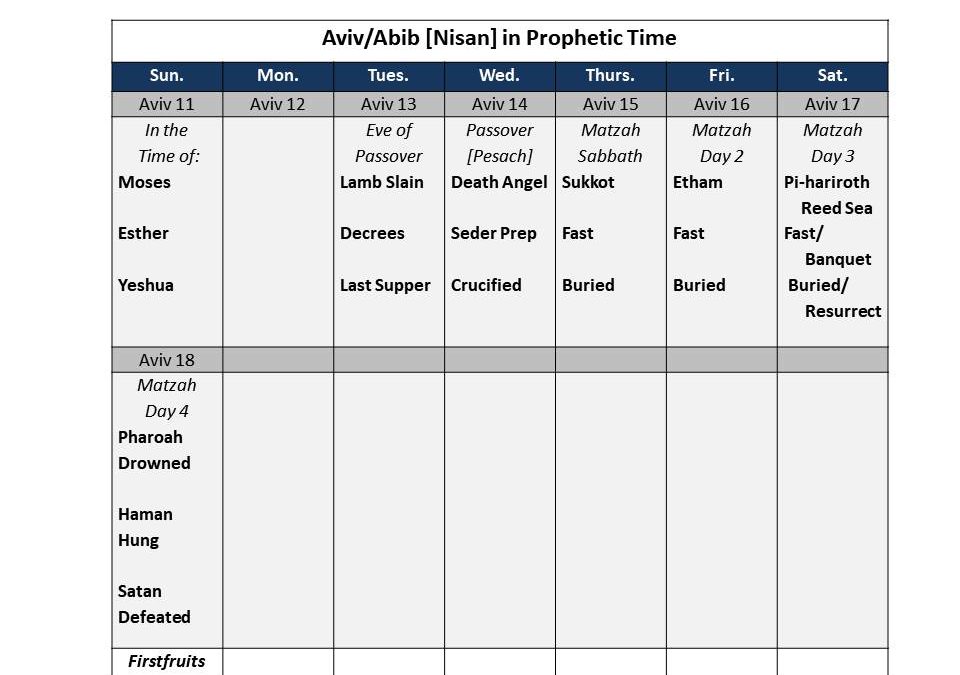
In the year of Yeshua’s death and resurrection, 30 A.D., the day of Passover, Aviv [Nisan] 14th, was the fourth day of the week, a Wednesday. The day of Aviv 10th in that year, a day traditionally known by Christians as Palm Sunday, was on the weekly Sabbath, a Saturday (Palm Sabbath).  Four days after the Lamb of God was taken and examined in the Temple, He was labeled with the title, “The King of the Jews”, and hung upon the cross. Messiah Yeshua was lifted up on the tree on the fourth day of the week. Counting that day, and the three days in nights He was in the tomb, brings us to Aviv 18, four days later.

The number four has to do with authority. On day four of creation, the sun, moon, and stars were created, to rule the earth. The lights in the heavens govern our calendar, by determining the Feasts of the LORD. “And God said, Let there be lights in the firmament of the heaven to divide the day from the night; and let them be for signs, and for seasons  [moedim – feasts], and for days, and years” (Genesis 1:14).

In 30 A.D. Yeshua gave up His authority, and died on the fourth day, at the time the Temple Passover lambs were slaughtered, the ninth hour. He was placed in the tomb for three nights and three days. At the end of the weekly Sabbath, at the time of Havdalah, Messiah Yeshua was resurrected from the tomb, defeating the power of death. The timing of this was at the beginning (the evening) of the Biblical holiday of First Fruits. His resurrection destroyed the power of the Enemy, and made a public spectacle of Satan. “Knowing that Messiah being raised from the dead dieth no more; death hath no more dominion over Him” (Romans 6:9) “And having spoiled principalities and powers, He made a shew of them openly, triumphing over them in it.” (Col. 2:15)

Centuries prior, during this same days on the Biblical calendar, Queen Esther and her people, also “died” to themselves in fasting and prayer. At the end of those three days and nights, at the time of Havdalah, Esther entered the King’s chamber, unannounced, and invited the King to the first of two banquets. She risked her life to save her people from perishing. This was also the eve of First Fruits.

At the first banquet, Esther did not tell the King her reason for her bursting forth into his throne room, but instead, invited the king to a second banquet. After the first banquet with the king and queen, Haman [Boo] was puffed up in his pride, but he could not enjoy the moment, as long a Mordecai The Jew existed. After complaining to his wife and friends, he took their advice, and had gallows built, with the plans to hang Mordecai, the very next day, the day of First Fruits.

The events that transpired, on this first day of the week, are a dramatic irony. Haman sought his own honor, only to be publicly disgraced when Mordecai The Jew was lifted up and paraded in royal splendor. Humble Mordecai, was raised up in honor, to the humiliation of Haman. The very gallows that Haman built for the destruction of The Jew, instead, came upon his own head. The planned destruction of The Jew, was transformed into redemption for the Jewish people.

As Mordecai The Jew was lifted up in the days of Esther, so would the King of the Jews be lifted up in the year 30 A.D.  As the enemy Haman was exposed, so was the Enemy Satan put to shame. Timing is everything with our God. Haman should have known, that Yahweh rules and reigns. The appointments God has on His calendar will be kept, for the redemption of the world.  His times and His seasons are His reasons for His people to rejoice and celebrate. Purim and the Biblical Spring Feast days of Passover, Unleavened Bread, and the First Fruits of the Resurrection, are those very days for us to rejoice in.

As we celebrate this year, may our traditional mealtime blessing be enhanced, as we link Purim to Passover, with the understanding of, “Blessed are You, Adonai, who brings forth the Bread (of Life) from the Earth (the tomb). Messiah Yeshua, The Bread of Life, The King of the Jews, was resurrected on the exact same day that Mordecai The Jew was lifted up and honored.  Death was defeated on First Fruits, both in Esther’s day, as well as for eternity by Messiah Yeshua. This is why Psalm 22 is about redemption for both the Jew and non-Jew. A coincidence? Not with God.

Blessed are you O LORD, Who has brought us to this time and season. Chag Sameach!

Purim and the Passover Deliverance Calendar

Purim and the Passover Deliverance Calendar

The miraculous Passover deliverance from Egypt was accomplished within the same three days and three nights on the Jewish calendar as the passion of Messiah Yeshua was in Ancient Israel. There are amazing parallels, found in the first exodus, that are also displayed in the sign of Jonah during the death, burial, and resurrection of Messiah. Delving into these connections relates how Messiah fulfilled the season of Passover.

It was with great with great signs and wonders, that Avinu Malkeinu (our Father our King) delivered the Hebrews, from slavery, in the land of Egypt. The awesome wonder of that ancient event is still remembered each spring as the faithful sit together to celebrate the Passover Seder meal. Interestingly, according to Scripture, there will soon be a greater exodus, with such a vast deliverance for the Chosen of the LORD, that it will overshadow the Egyptian exodus. This future event will be so momentous, that the former, will not be mentioned anymore. The prophet Jeremiah foretells of this day.

Therefore, behold, the days come, says the LORD, that they shall no more say, The LORD lives which brought up the children of Israel out of the land of Egypt; but, The LORD lives, which brought up and which led the seed of the house of Israel out of the north country, and from all countries whither I had driven them, and they shall dwell in their own land. (Jer. 23:7-8 KJV)

When we look to the Torah concerning these things, much is revealed about the prophetic events that are soon to unfold. In the spring, as we observe Passover, we look back into history at the faithfulness of Yahweh Almighty to deliver His people from bondage. We also will celebrate as a rehearsal for the prophetic Kingdom when the righteous Branch of David, Messiah Yeshua, will gather us back to the Promised Land where He will reign upon the earth as our King.

In the exodus from Egypt, we find, “…the LORD brought us forth out of Egypt with a mighty hand, and with an outstretched arm, and with great terribleness, and with signs, and with wonders.” (Deut. 26:8) In this passage, the Hebrew word for “signs” stands for signals, or distinguishing marks. In recent years, because of the attention on the four blood moons, believers in Messiah are noticing the signs in the heavens. God is revealing these signals for the purpose of drawing attention back to His calendar, His timing, and His feasts. The Hebrew word for “wonders” means a miraculous display of God’s power or tokens of a future event. Therefore, based on this understanding, of the first exodus, we should expect signs and wonders to happen among us in the greater exodus to come.

The purpose of the LORD’s signs and wonders are to establish His Word and authority, to His chosen people and to the nations. The signs were given to generate belief and trust in Adonai and for the faithful to know that He is present in the midst of crisis.

And Aaron spoke all the words which the LORD had spoken unto Moses and did the signs in the sight of the people. And the people believed: and when they heard that the LORD had visited the children of Israel and that He had looked upon their affliction, then they bowed their heads and worshiped. (Exo. 4:30-31 NAS)

True signs and wonders of the Almighty cause people to bow down in reverence, not fall back in disbelief. To kneel and bow down is an act of voluntary submission to Him. The LORD used signs and wonders to display His power before Pharaoh, but Pharaoh refused to believe in God’s Word.

And the LORD said unto Moses, See, I have made thee a god to Pharaoh: and Aaron thy brother shall be thy prophet. Thou shall speak all that I command thee…And I will harden Pharaoh’s heart, and multiply my signs and my wonders in the land of Egypt…Pharaoh shall not hearken unto you, that I may lay my hand upon Egypt, and bring forth mine armies, and my people the children of Israel, out of the land of Egypt by great judgments. (Exo. 7:1-4 KJV)

The Holy One’s purpose in displaying His power was for the Egyptians to have the opportunity to “…know that I am the LORD, when I stretch forth mine hand upon Egypt, and bring out the children of Israel from among them.” (Exo. 7:5) Signs and wonders, even when they are used as judgments upon people, can be part of the Father’s mercy toward unbelievers. It was through His signs and wonders that many Egyptians came to believe in His Word.  (See more about the plagues of Egypt in the Appendix.)

At the time of the Exodus from Egypt, after the death of the firstborn, the Hebrews set out on the 15th day of Nissan/Aviv. They traveled by the light of an illuminated full moon to camp at Sukkot, which was the first stop on their freedom journey.

Now the sons of Israel journeyed from Rameses to Succoth, about six hundred thousand men on foot, aside from children. A mixed multitude [“an ethnically diverse crowd” – according to the HCB translation] also went up with them, along with flocks and herds, a very large number of livestock. (Exo. 12:37,38 NAS)

Many Egyptians also left Egypt along with the children of Israel. The fearful signs and wonders caused them to join the Hebrew slaves as they learned that the gods of Egypt were false. Forsaking all the world they had known, they clung to the truth of the Holy One of Israel. This mixed multitude of people represented the first converts to the monotheistic faith of the Israelites. Adonai is a God of inclusion. He desires as many people, those “whosoever wills”, to come into His Kingdom. Salvation is the process of being redeemed from darkness and being brought into the marvelous Light of the Word of God. When the plagues hit Egypt, the Egyptians were also given a choice of who to serve. Many chose to abandon Egypt and flee along with the children of Israel. Not only were the slaves of the children of Israel being set free, so also were the God-fearers of Egyptian heritage. The deliverance of Exodus was to the Jew first, then to the non-Jew. Both exited Egypt in one accord in reverence to Adonai.

An important note is that during the confrontations between Pharaoh and Moses, the request for the children of Israel. They were to be given a three-day reprieve from slavery to go into the wilderness to celebrate a feast unto Adonai. The original request by Moses to Pharaoh was not for the release from captivity but for the freedom to worship, the freedom to celebrate a feast, one that would take a three day’s journey to accomplish.

And afterward, Moses and Aaron came and said to Pharaoh, “Thus says the LORD, the God of Israel, ‘Let My people go that they may celebrate a feast to Me in the wilderness.’” But Pharaoh said, “Who is the LORD that I should obey His voice to let Israel go? I do not know the LORD, and besides, I will not let Israel go.” Then they said, “The God of the Hebrews has met with us. Please, let us go a three days’ journey into the wilderness that we may sacrifice to the LORD our God, otherwise He will fall upon us with pestilence or with the sword.”  But the king of Egypt said to them, “Moses and Aaron, why do you draw the people away from their work? Get back to your labors!” (Exo. 5:1-4 NAS – see also Exo. 7:16, Exo. 8:1, Exo. 9:1, and Exo. 10:3)

You shall say to him, The LORD, the God of the Hebrews, sent me to you, saying, “Let My people go, that they may serve Me in the wilderness.” But behold, you have not listened until now. (Exo. 7:16) – Plague of Blood

Then the LORD said to Moses, “Go to Pharaoh and say to him, Thus says the LORD, Let My people go, that they may serve Me.” (Exo 8:1 NAS) – Plague of Frogs

Now the LORD said to Moses, “Rise early in the morning and present yourself before Pharaoh, as he comes out to the water, and say to him, Thus says the LORD, “Let My people go, that they may serve Me.” For if you will not let My people go, behold, I will send swarms of insects on you and on your servants and on your people and into your houses; and the houses of the Egyptians shall be full of swarms of insects, and also the ground on which they dwell. “But on that day I will set apart the land of Goshen, where My people are living, so that no swarms of insects will be there, in order that you may know that I, the LORD, am in the midst of the land. And I will put a division between My people and your people. Tomorrow this sign shall occur.” (Exo. 8:20-23) – Plague of Lice

Then the LORD said to Moses, “Go to Pharaoh and speak to him, ‘Thus says the LORD, the God of the Hebrews, “Let My people go, that they may serve Me.” (Exo. 9:1 NAS)

Moses and Aaron went to Pharaoh and said to him, “Thus says the LORD, the God of the Hebrews, How long will you refuse to humble yourself before Me? Let My people go, that they may serve Me.” (Exo. 10:3 NAS)

Remember the original request was for a three-day journey into the wilderness to celebrate a feast unto Adonai. The Pharaohs of this world and their religious leaders that follow them do not want the people of Adonai to serve Him by celebrating His feast days. Liberty opens the door for the captives to be freed to worship the Holy One in Spirit and truth. Passover is the season that celebrates this freedom.

On the following day, the 16th of Nisan/Abib, the children of Israel and the diverse crowd of Egyptians set out and traveled to the next encampment at Ethan, on the edge of the wilderness.

Then they set out from Succoth and camped in Etham on the edge of the wilderness. And the LORD was going before them in a pillar of cloud by day to lead them on the way, and in a pillar of fire by night to give them light, that they might travel by day and by night. He did not take away the pillar of cloud by day, nor the pillar of fire by night, from before the people. (Exo. 13:20-22 NAS)

The third day out of Egypt, on the 17th day of the month, the escaping slaves and run away Egyptians traveled to Pi-harioroth. There they camped in a vulnerable position by the sea.

Now the LORD spoke to Moses, saying, “Tell the sons of Israel to turn back and camp before Pi-hahiroth, between Migdol and the sea; you shall camp in front of Baal-zephon, opposite it, by the sea. “For Pharaoh will say of the sons of Israel, ‘They are wandering aimlessly in the land; the wilderness has shut them in.’  “Thus I will harden Pharaoh’s heart, and he will chase after them; and I will be honored through Pharaoh and all his army, and the Egyptians will know that I am the LORD.” And they did so. (Exo. 14:1-4 NAS)

These three days of journeying in the wilderness were related to the three days and nights of Messiah Yeshua’s burial in the tomb. On the Hebrew calendar, they are the same three days, the 15th, 16th, and 17th of Nisan/Abib. When the three day journey into the wilderness had come to its conclusion, Pharaoh realized that the slaves of Egypt were not coming back to serve him. In anger he set off to force the children of Israel back into submission.

Then the Egyptians chased after them with all the horses and chariots of Pharaoh, his horsemen and his army, and they overtook them camping by the sea, beside Pi-hahiroth, in front of Baal-zephon. And as Pharaoh drew near, the sons of Israel looked, and behold, the Egyptians were marching after them, and they became very frightened; so the sons of Israel cried out to the LORD. (Exo. 14:9-10 NAS)

It was at this climatic moment, when the Israelites were trapped at the sea that Yeshua became a present help to them in their time of trouble. In order to witness the defeat of Pharaoh, who is a type of Satan, the fleeing Egyptians and the children of Israel, were ordered to stand still and watch.

But Moses said to the people, “Do not fear! Stand by and see the salvation [Yeshua] of the LORD which He will accomplish for you today; for the Egyptians whom you have seen today, you will never see them again forever. The LORD will fight for you while you keep silent.” Then the LORD said to Moses, “Why are you crying out to Me? Tell the sons of Israel to go forward. And as for you, lift up your staff and stretch out your hand over the sea and divide it, and the sons of Israel shall go through the midst of the sea on dry land. And as for Me, behold, I will harden the hearts of the Egyptians so that they will go in after them; and I will be honored through Pharaoh and all his army, through his chariots and his horsemen. Then the Egyptians will know that I am the LORD, when I am honored through Pharaoh, through his chariots and his horsemen.” And the angel of God, who had been going before the camp of Israel, moved and went behind them; and the pillar of cloud moved from before them and stood behind them. So it came between the camp of Egypt and the camp of Israel; and there was the cloud along with the darkness, yet it gave light at night. Thus the one did not come near the other all night. (Exo. 14:13-20 NAS)

During the dark hours of the night, before the break of dawn, the freed populous of Egypt, both native born Israel and those that sojourned with them, was delivered as the pillar of cloud stood between them and the chariots of Pharaoh. This day of Salvation for the deliverance of the faithful of Adonai is the same night that nearly 1500 years later Yeshua defeated death during His resurrection from the tomb. It was in the dark of night that the deliverance was made and in the light of day the defeat of Pharoah, a type of Satan, was revealed. This day in the Bible is a day to be recognized. It is not Easter but the Biblical holiday of Firstfruits, the day that Pharoah was defeated in the sea.

Then Moses stretched out his hand over the sea; and the LORD swept the sea back by a strong east wind all night, and turned the sea into dry land, so the waters were divided. And the sons of Israel went through the midst of the sea on the dry land, and the waters were like a wall to them on their right hand and on their left. Then the Egyptians took up the pursuit, and all Pharaoh’s horses, his chariots and his horsemen went in after them into the midst of the sea. And it came about at the morning watch that the LORD looked down on the army of the Egyptians through the pillar of fire and cloud and brought the army of the Egyptians into confusion. And He caused their chariot wheels to swerve, and He made them drive with difficulty; so the Egyptians said, “Let us flee from Israel, for the LORD is fighting for them against the Egyptians.” Then the LORD said to Moses, “Stretch out your hand over the sea so that the waters may come back over the Egyptians, over their chariots and their horsemen.” So Moses stretched out his hand over the sea, and the sea returned to its normal state at daybreak, while the Egyptians were fleeing right into it; then the LORD overthrew the Egyptians in the midst of the sea. And the waters returned and covered the chariots and the horsemen, even Pharaoh’s entire army that had gone into the sea after them; not even one of them remained. But the sons of Israel walked on dry land through the midst of the sea, and the waters were like a wall to them on their right hand and on their left. (Exo. 14:21-29)

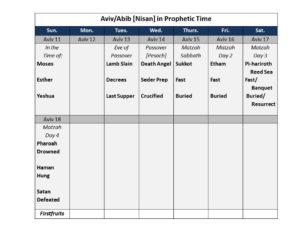
The Passover deliverance was three days and three nights after the blood was applied to the lintels and doorposts in Egypt. The same Passover deliverance was accomplished during the same three day and three night time period of Messiah Yeshua. Timing is everything with our God. The death, burial, and resurrection of the Messiah of Israel was demonstrated in the days of Moses in Egypt, and a second time in the days of Queen Esther of Persia. (Please refer the diagram below to see the parallels between the Exodus from Egypt, the Trials of Esther, and the Passion of Messiah.)

To learn more about the Parallels between Purim and Passover look for the upcoming BEKY Book by Jane Diffenderfer titled, The Three Days and The Three Nights of Messiah.

Purim and the Passover Deliverance – Part 2

Purim and the Passover Deliverance – Part 2

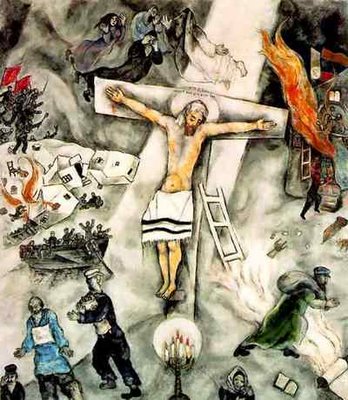
marc chagall white passover

In the year 30AD, the day of Passover, Nisan 14, was the fourth day of the week, a Wednesday. (4) What is traditionally know as Palm Sunday, was actually Palm Sabbath, that year, and it fell on Nisan 10. Four days after the Lamb was taken and examined in the Temple, He was labeled as the Yahweh’s Lamb, with the title The King of the Jews, and mocked as He hung on the cross. The number four has to do with authority. (5)  Yeshua gave up His authority and died on the fourth day, at the time the Passover lambs were slaughtered in the temple. The background music of the Hallel (Psalm 113-118) was sung by the Levites as Yeshua took His last breath. (6)

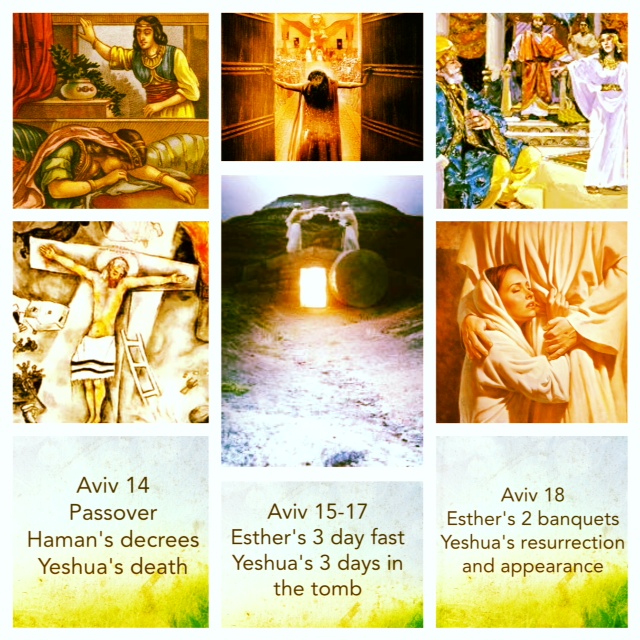
He was taken down from the tree and buried in the tomb before the annual Sabbath of Unleavened Bread, Nisan 15, began. In Hebraic reckoning, days begin with nightfall, the evening prior. Which means Yeshua was in the tomb at the end of the 14th of Nisan just as the day of Nisan 15, began. He remained there for three entire nights, and three entire days. At the end of the three nights and days, He came forth from the grave as the eve of the Biblical feast of First Fruits, began.

During this same three days, centuries prior, Queen Esther also had her people, die to themselves in fasting and prayer, for the sake their deliverance, during these same three days. Do you think there is a coincidence in the timing? Not with Yahweh!

At the end of the three day fast, Esther invites King Ahasuerus and Haman to a feast. This first banquet, at the beginning of the Biblical holiday of First Fruits is the initiation of the exposure of the Adversay. The queen is obviously deeply distressed and the king is willing to give her up to half of his kingdom, to give her peace. When asked, Esther declines to tell the king what her source of trouble is and instead, invites Haman and the King to another banquet the following night.

In the night between these feasts or banquets, the King’s sleep is shaken and he is up through the wee hours, reading the chronicles of his life.  Perhaps he is searching for something to give him a clue to what has disturbed his Queen? In reading about a past assassination attempt, the king realizes that he omitted honoring the man who once saved his life, Mordecai, the Jew.

Haman also has a troubled night, because he has no patience to wait eleven months for the death of Mordecai. He has to have it now! How ironic, both the King and Haman can’t sleep and both are focused on Mordecai, the Jew.

Another irony, on the 18th day of Nisan, the King decides to honor the Jew, the one who saved his life. To twist the irony even deeper, the honoring is done at the advice of prideful Haman, who thought more highly of himself then he ought to.  Mordecai the Jew, is  then exalted with royal robes, and paraded on one of the King’s horses, throughout the whole city of Shushan with the words, “Thus shall it be done to the man whom the king delights to honor” (Esther 6:9).  This lifting up of Mordecai the Jew, was the exact opposite of the intention of Haman’s vile heart. Haman intended to lift Mordecai up on the gallows of humiliation, and God intended to see him lifted up in kingly honor. The full fury of Haman’s wrath must have reached its peak that First Fruits of Nisan 18, when he was suddenly escorted into the king’s presence for his last supper with Esther. During this feast, the Queen, whose identity and ancestry was hidden until this precise time, exposes the Enemy and delivers his head to the very same gallows, which Haman had erected to kill Mordecai. The weapon he had designed to destroy the Jew, came back upon his own head.

For the saints, the picture is clear. The King will exalt to honor the Jew, who is willing to die (“if I perish, I perish”) for the sake of his (or her) people and will lead them in triumph over every Enemy. Those who plot against the work of Yahweh will be exposed, for who they are, just as Satan was exposed at the resurrection. Yeshua, the Bread of Life, came forth from the ground as the First Fruits of the resurrection. We speak this truth every Sabbath eve with the words, “Blessed are you Adonai/Yahweh, King of the universe, who brings forth Bread from the earth.” The 18th day of Nisan confounded the work of the Enemy and will always be remembered as the victory for the saints. Yeshua’s death on the cross, erased the decree of destruction for us, and made a public spectacle of Satan. What the Adversary meant for harm on Nisan 13, God triumphed over on Nisan 18. Yeshua gave up His authority on earth and died on the fourth day of the week. Four days later, with His ascension on First Fruits, He took back that authority, and ended Satan’s dominion over mankind.

“For in Him [Messiah Yeshua] dwells all the fullness of the Godhead bodily and ye are complete in Him, which is the head of all principality and power:  In whom also ye are circumcised…Buried with Him in baptism, wherein also ye are risen with Him through the faith… And you, being dead in your sins…hath He quickened together with Him, having forgiven you all trespasses; Blotting out the handwriting of ordinances that was against us…nailing it to His cross; and having spoiled principalities and powers, He made a show of them openly, triumphing over them in it.  Let no man therefore judge you… in respect of a holy day, or of the new moon, or of the sabbath days:  Which are a shadow of things to come…” Col. 2:9-17).

The saints are one people, with one hope, and one faith in the Most High God. Let no man deceive you or judge you according to the Sabbaths you choose to honor. Yeshua is our Passover and the First Fruits of the resurrection. The Biblical feasts are the Sabbaths set aside to honor the awesome work of our God. The Book of Esther teaches the Torah and the Testimony of Yeshua in shadows. The New Covenant Scriptures openly display the Torah of Yeshua and how He, as Messiah, fulfills the commandments of God in the Feasts of the LORD.

In the Book of Revelation there is only one group of people that will stir up the wrath of the Enemy to the vexation level of Haman.  It is the saints that know who they are and who obey the voice of their God. “…And the dragon was wroth with the woman, and went to make war with the remnant of her seed, which keep the commandments of God, and have the testimony of Jesus Christ [Yeshua Messiah]” (Rev. 12:17). This united group of people will be a powerful witness of the authority of the Kingdom of God over all the forces of darkness. They will shine as the people that know their God and they shall do exploits against the Pharoahs and Hamans of this world.

In conclusion, the covenant community of faith is the one, which keeps both the commandments of God, the Torah, and the Testimony of Yeshua. “To the law and to the testimony: if they speak not according to this word, it is because there is no light in them” (Isaiah 8:20).

May all those who read this, have the courage and patience of the saints, to stand as lights in this dark world, and overcome all the work of the Enemy. Yeshua is the Lamb, Who overcame and He leads His people in His victory. For He is the “Lord of lords and the King of kings; and they that are with Him are called, and chosen, and faithful” (Rev. 17:14). “And they overcame him [the Accuser of the brethren] by the blood of the Lamb, and by the word of their testimony; and they loved not their lives unto the death” (Rev. 12:11).  Many are called, few are chosen, and even fewer are faithful until death.

“All authority, every victory is Yours,

Saviour, Worthy of honor and glory

Worthy of all our praise, You Overcame

[Yeshua] awesome in power forever, You Overcame…

We will overcome, by the blood of the Lamb

And the word of our testimony…” (7)


(1)  The Creation Gospel, Book Two, The Seven Abominations of the Wicked Lamp by Dr. Hollisa Alewine.

(2)  Beth Moore, Esther – It’s Tough Being a Woman, page73, Lifeway Press, 2008)

(3)  Beth Moore, Esther – It’s Tough Being a Woman, page74, Lifeway Press, 2008)

(4)  www.rosetta calendar.com

(5)  The Creation Gospel, Book One, The Seven Spirits of God, One Holy Spirit by Dr. Hollisa Alewine

(6)  The Feasts of Adonai, Why Christians Should Look at the Biblical Feasts by Valerie Moody, page 33.

(7)  Lyrics to Jeremy Camp song titled Overcome.

Purim and the Passover Deliverance – Part 1

Purim and the Passover Deliverance – Part 1

Image

By Jane Diffenderfer

The Book of Esther is not just the story of “once upon a time in a kingdom far way”, it is a living lesson for the saints of the Most High. According to Revelation 14:12, these saints are defined as those, “…that keep the commandments of God and the faith of Jesus [Yeshua].” Question, are the saints of the Book of Revelation two people groups, those that keep the commandments (Jews), and another who hold on to the faith of Yeshua (Christians)? Or, are they, one group of people, with one faith, who hold on to both the Torah/law and the testimony? The Book of Esther is a veiled prophecy, which reveals an answer to who the End Times people of God will be.

In the days of Queen Esther and Mordecai the Jew, the King of Persia had written decrees that were to be carried out in every province within his jurisdiction. These decrees were craftily written at the direction of the adversary Haman. These evil decrees were to murder all the Jews in territories of King Ahasuerus’s domain, including Jerusalem. They were written “…on the thirteenth day of the first month…according to all that Haman had commanded…in the name of King Ahasuerus”…the posts were sent into all the king’s provinces, with orders that in eleven month’s time, on a future date, the people of the kingdom were to destroy, kill, and cause to perish, “all Jews, both young and old, little children and women…The posts went out, being hastened by the king’s commandment, and the decree was given in Shushan the palace. And the king and Haman sat down to drink, but the city Shushan was perplexed” (Esther 3:12-14). How horrific!

The issuing of these dispatches muster their prophetic impact when they are layered upon the Biblical feasts, as commanded in the Torah (the first five books of Moses). What is the 13th day of the first month?  According to Scripture, the first month is Nisan (or Aviv). What significance does this date have for Christians (those that have the testimony of Yeshua)? It is the day before Passover, the anniversary of the Last Supper, which was shared in the Upper Room. What do the Jews (those that keep the commandments) do on the 13th day of the first month? Prepare for Passover, the remembrance of the deliverance from Egypt.

During the reign of King Ahasuerus, the entire kingdom was confounded by the orders issued. But not Haman, the Agagite; he sat down to eat, drink, and be merry. Haman was of the seed of Amalek, the seed of Satan. He was following after his father the devil, with his murderous decrees and had no conscience about it. He must have been gloating that his orders were being sent out and distributed on the 14th of Nisan, just as Jewish parents were sitting down with their children to eat their Passover meal. What a total shock this news would be to the Jews, on the day set aside to celebrate their deliverance from Egypt! Not only were they being issued a death sentence, to be enacted eleven months later, their neighbors were forced, by the decree to commit the crime against them. No wonder everyone was perplexed in Shushan! Haman must have licked his chops at the idea that he had concocted such a scheme, to ruin the special feast of those he hated so passionately.

All seven of the abominations of the wicked one from Proverb 6 were emboldened in Haman. Haman was arrogant, who spoke lies against the Jews, and persuaded the king through his false witness, to give his royal stamp of approval to the evil imagination of his heart, the shedding of the innocent blood of Abraham’s seed. Haman acted swiftly in sending his dispatches throughout the provinces to sow discord in the kingdom. In one day, by one decree, neighbor was set against neighbor. The wicked lamp (1) illuminated in Haman had one agenda, death. Haman was not content with just one word, “kill” in his murderous decree. His agenda was to “kill, destroy, and annihilate” the Jewish people because “their laws are diverse from all people” (Esther 3:8). Haman despised the Torah and the people who kept the commandments of their God. The seed of Amalek hated the seed of Abraham with such blazing wrath, that Haman wanted to wipe the Torah honoring faithful from the face of the earth. This is a prophetic picture that continually repeats throughout time and history.

A fool says in his heart, there is no God. Haman was a fool, yet he thought he was wise. God in heaven cannot be mocked by men. He is a strong Deliverer and He will deliver His people, no matter what force of darkness comes against them. “Gather this into your soul: When all is said and done, Satan can’t win and you can’t lose… God always trumps Satan. Every hope and every victory the enemy thinks he has is maddeningly thwarted at the perfect time…His first giveaway should have been the timing.” (2)

The edict was written on the 13th day of Nisan and delivered on the 14th, just as the Jews in all the provinces were preparing to remember the Exodus from Egypt. This great deliverance celebration is an annual reminder of Yahweh’s ability to save His people through great signs and wonders. It is a night that parents are instructed to remind their children of God’s saving power by retelling the events of the destruction of Pharoah’s army. What a night to remember! With the news of Haman’s command, “what was meant to be a commemoration of a past event, suddenly turned into a concert of imminent need. Decades earlier, the Persian Jews had chosen not to take advantage of their deliverance under the decree of Cyrus, and their permission to return to Jerusalem. They decided they liked Persian life and stayed put. Then [along] came Haman. Maybe that’s one reason God allows ‘Hamans’ to come along in life – so we will quit being so at home here.” (3)

Those who had faith, during the dark hours of the death threat, could hope in the same God, Who delivered them from the bonds of Pharaoh, would also be able to deliver them from the hand of Haman. The saints are told to rehearse and remember the events of the Exodus. “And it shall come to pass when your children shall say unto you, ‘What mean ye by this service?’ That ye shall say, It is the sacrifice of the LORD’S [Yahweh’s] Passover, who passed over the houses of the children of Israel in Egypt when He smote the Egyptians and delivered our houses…” (Exodus 12:26-27). Remembering to observe the commandments of Passover, reminds us once again, of how great our God is!

For those who know Messiah Yeshua, Passover takes on an even deeper meaning of redemption. Yeshua, the Lamb of God, came to die to deliver His people from the bondage of sin. Passover is the annual memorial of our escape from the merciless control of the power of sin. The Passover seder has clues of eternal significance, For as often as ye eat this bread [the unleavened bread of Passover], and drink this cup [the cup of redemption – the third cup of the Seder] ye do show the Lord’s death till He come” (1 Cor. 11:26).

When our Purim heroine, Queen Esther, learns of Haman’s evil decree, instead of feasting, she declares a fast. This fast lasts for three days and three nights. It begins on the first day of Unleavened Bread, Nisan 15th, and continues through the 16th and 17th of Nisan. What is the spiritual and prophetic impact these days have for Believers? These are the same days that Yeshua, was buried in the tomb!

End of Part 1 – Please read Part 2 of Purim and the Passover Deliverance, click on this link below: